Most read
How to Legally Own and Register Exotic Pets in India
A Complete Guide to Understanding the Laws, Registration Process, and Responsibilities of Exotic Pet Ownership in India

5 Min Read
13 Aug, 2025
Social share
Or copy link
https://www.happypet.care/media/guides/rescue/how-to-legally-own-and-register-exotic-pets-in-india-1
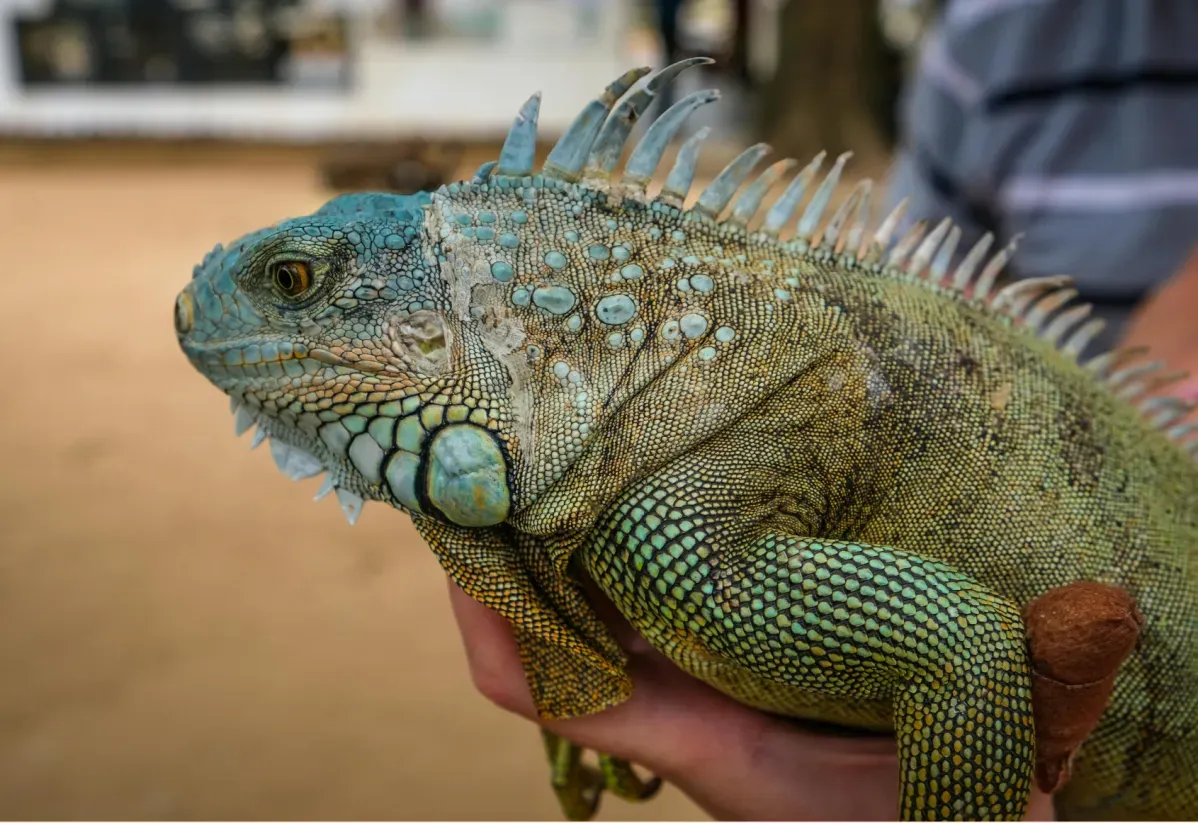
Most of us personally know someone who owns a parrot or some other bird or small mammal. We have even seen pet stores showcase colorful parrots and other small pets. If you have wondered “is it legal to own Exotic pets in India?”
We need to answer that question from multiple angles. First - what is the definition of ‘Exotic’? Second - since they are sold openly in pet stores or on FaceBook - doesn't that make them legal? Wouldn't the authorities clamp down on them first? Well the answer to the first one is straight forward and the second one is a little more nuanced. Read on to understand the rules and regulations in more detail.
The short answer is - animal ownership is tightly regulated by central and international law, and failure to comply can result in hefty penalties, seizure of animals, or even criminal prosecution. The reality is that the authorities do not have the resources to enforce those rules and regulations.
In this comprehensive guide from Happy Pet, you’ll learn exactly what the law says about keeping exotic pets in India, how the nationwide Parivesh portal works for registration, what amnesties mean for owners with undocumented animals, and how rules apply to numerous species from birds and reptiles to small mammals.
Understanding “Exotic Pets” Under Indian Law
Exotic pets refer to species that are not native to India and are not listed as protected under the schedules of the https://cpc.parivesh.nic.in/writereaddata/WildLifeAmedmentAct2006.pdf.
This includes more common birds like African grey parrots, South American macaws, as well as reptiles, amphibians, some turtles and tortoises, monkeys, and small marsupials.
Legal vs Illegal: Native vs Exotic Species
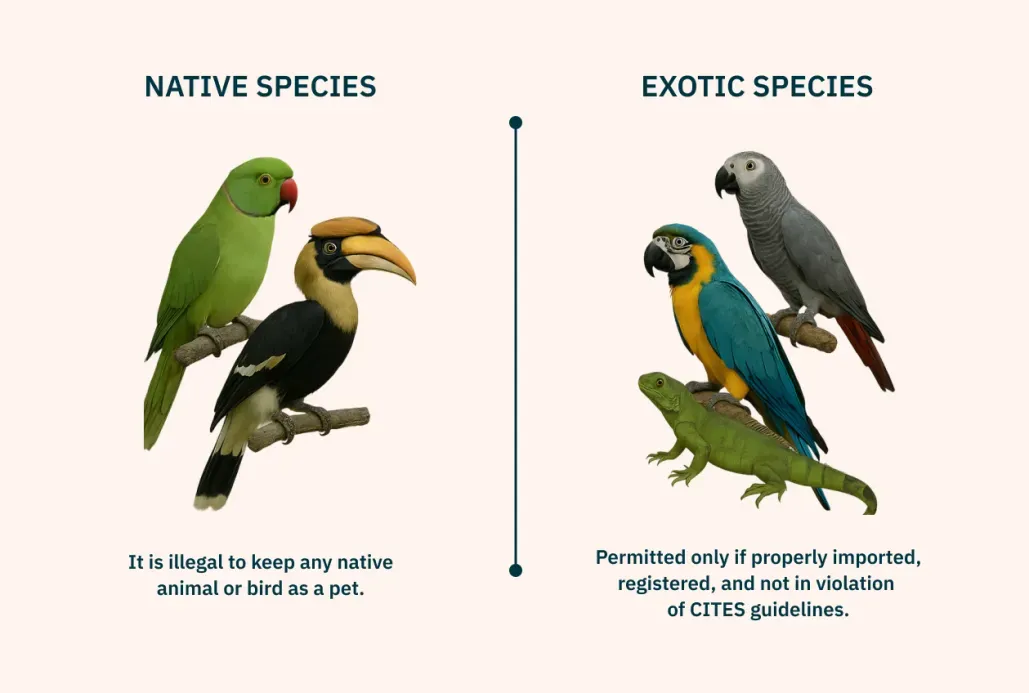
- Native birds (e.g., Indian Ringneck parakeets or the Great Indian Hornbill): It is illegal to keep any native animal or bird as a pet. Possession, trade, or breeding of Indian species is barred regardless of how they were acquired.
- Exotic pets (e.g., African grey parrots, blue-gold macaw, iguanas, exotic turtles): Permitted only if properly imported, registered, and not in violation of CITES (Convention on International Trade in Endangered Species) guidelines.
The Role of CITES (International Regulation)
Many exotic pets popular in India fall under CITES Appendices:
- Appendix I: Most endangered (e.g., African grey parrot, Scarlet macaw, many primates). Wild-caught trade is generally banned, captive-bred animals require strict paperwork.
- Appendix II: Trade controlled (e.g., blue-gold macaw, some turtles, snakes, and lizards), permits required.
- Appendix III: Less controlled, trade monitored.
Example:
- African Grey Parrot (Psittacus erithacus): Appendix I, highest protection.
- Blue-and-yellow Macaw (Ara ararauna): Appendix II, regulated trade.
- Red/Scarlet Macaw (Ara macao): Appendix I, strictest controls.
What This Means: Legal ownership of an Exotic pet in India not only depends on national law but also international classification. Therefore it is important to understand the legality and to check before you decide to buy an exotic pet.
The Indian Regulatory Framework
Parivesh Portal: The Nationwide Registration System

India mandates that all exotic pet owners declare possession and register their pets using the Parivesh Portal, a centralized online system managed by the Ministry of Environment, Forest and Climate Change (MoEFCC).
Who Must Register?
Every individual or institution that owns an exotic species (birds, reptiles, mammals, etc.), regardless of state must register.
When Must You Register?
- For old pets: During the amnesty period (as notified; e.g., up to August 28, 2024 for certain species).
- For new acquisitions: Within 30 days of buying or acquiring the exotic animal/bird.
Steps to Register Exotic Pets
- Access the Parivesh Portal: Go to https://parivesh.nic.in/
- Select Your State and District: Registration is national, but the portal records your local details.
- Fill in Pet Details:
- Species information (scientific and common name)
- Number of animals
- Sex and age (if known)
- Photos of the animal and its enclosures
- Provide Owner Details: Name, address, and KYC documentation.
- Self-Declaration: If you lack paperwork (import/ownership documents), declare this truthfully during amnesty. Do not submit forged records.
- Submit Application: Download or print the acknowledgment.
Tip: A veterinary health certificate may be asked for but is not always compulsory.
Amnesty: What Is It and Why Is It Important?
Amnesty is a grace period announced by the Indian government allowing owners to register exotic pets already in their possession—often without having to produce paperwork proving legal acquisition/import. It is a way to bring unregistered or “grey market” animals into legal compliance, safeguarding both the animals and the owner from prosecution.
How Amnesty Works:
- Only applies during the notified period.
- Owners voluntarily declare animals in their possession.
- No immediate proof of import or purchase is needed; self-declaration is permitted.
- After amnesty, all acquired pets must be registered within 30 days of possession with supporting paperwork.
Post-Amnesty: Keeping unregistered Appendix I or II species, especially without proof, can lead to legal consequences including confiscation and penalties.
Registering a Captive-Bred CITES Animal
Registering captive-bred (not wild-caught) birds and animals involves:
- Source from a Registered Breeder: Only buy from breeders with proper CITES authorization.
- Keep Documentation: Proof of captive-breeding (certificate, microchip, closed ring) is crucial.
- Register on Parivesh: Submit captive-breeding paperwork along with the pet’s details.
- CITES Permits for Trade: For export/import, you’ll need export/import permits from both countries’ CITES Management Authorities.
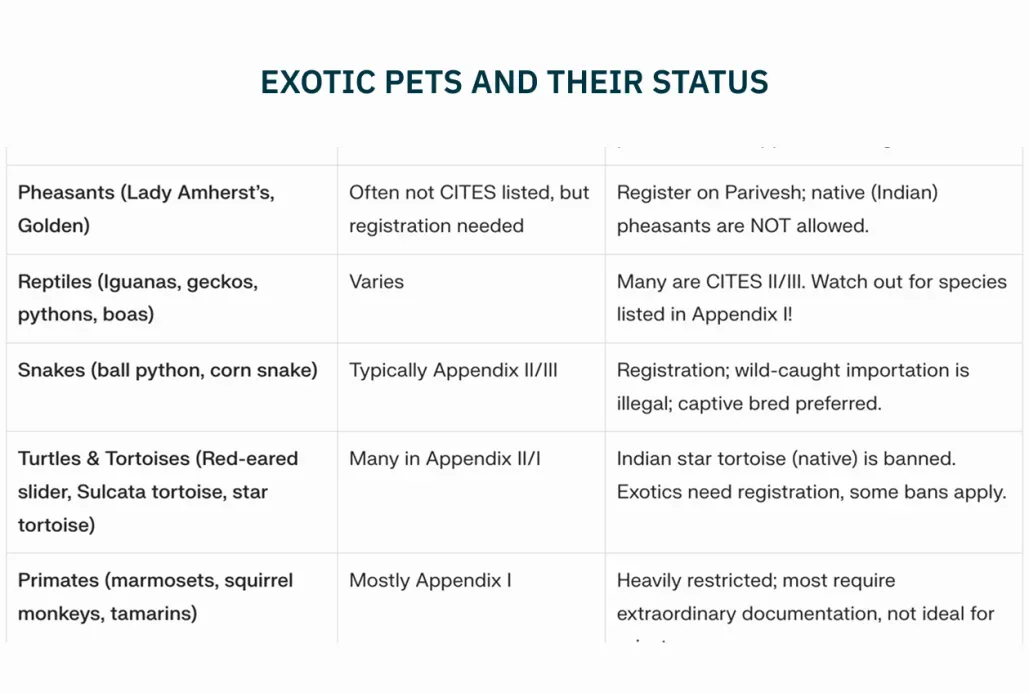
Commonly Kept Exotic Pets in India – And Their Legal Status
What Happens After Registration?
- Legal Status: Your pet is officially recognized and legal.
- Record Changes: Report transfer, death, breeding, or escape on the portal.
- Inspections: Keep pets in humane, safe conditions; authorities may inspect.
- Moving States: Update registration details if you relocate.
What If You Miss the Deadline?
Approach your local forest department or Wildlife Warden immediately. Some provisions may exist for late registration on a case-by-case basis, especially if you approach voluntarily, but penalties can apply after amnesty ends.
Key Takeaways and Practical Tips
Never buy exotic animals that lack clear captive-bred proof and CITES paperwork.
- Register all exotic animals, even if you have no paperwork, during announced amnesty periods—honesty shields you from prosecution.
- Do not keep native Indian species as pets—this is strictly illegal.
- Completing registration on the Parivesh portal is mandatory and applies nationwide.
- If in doubt, seek advice from your local forest department or legal professional.
Owning an exotic pet in India can be a fulfilling journey if you respect both animal welfare and the law. By following these procedures, you’re not only safeguarding your pet and yourself, but also supporting global conservation efforts.
Conclusion
Owning an exotic pet in India is more than just a hobby — it’s a legal responsibility. While these animals bring beauty and uniqueness into our lives, they also require strict adherence to both national and international regulations.
written by
Thammu AiyappaAuthor